
Crypto casino review
Thrill Review
Thrill is a crypto-native casino launched in 2025 with 15 supported crypto assets, multi-chain payments, a large third-party game catalog, its own provably fair originals, and an XP-centered rewards system. The practical trade-offs sit in the details: networks change transaction handling, cashout checks can appear later in the account lifecycle, and independent trust signals point in sharply different directions.

Table of Contents
- Thrill puts crypto access ahead of a conventional casino setup
- Network choice can change the payment experience before the game starts
- Check how a cashout amount fits the current cashier
- Rewards work through XP progression rather than a first-deposit headline
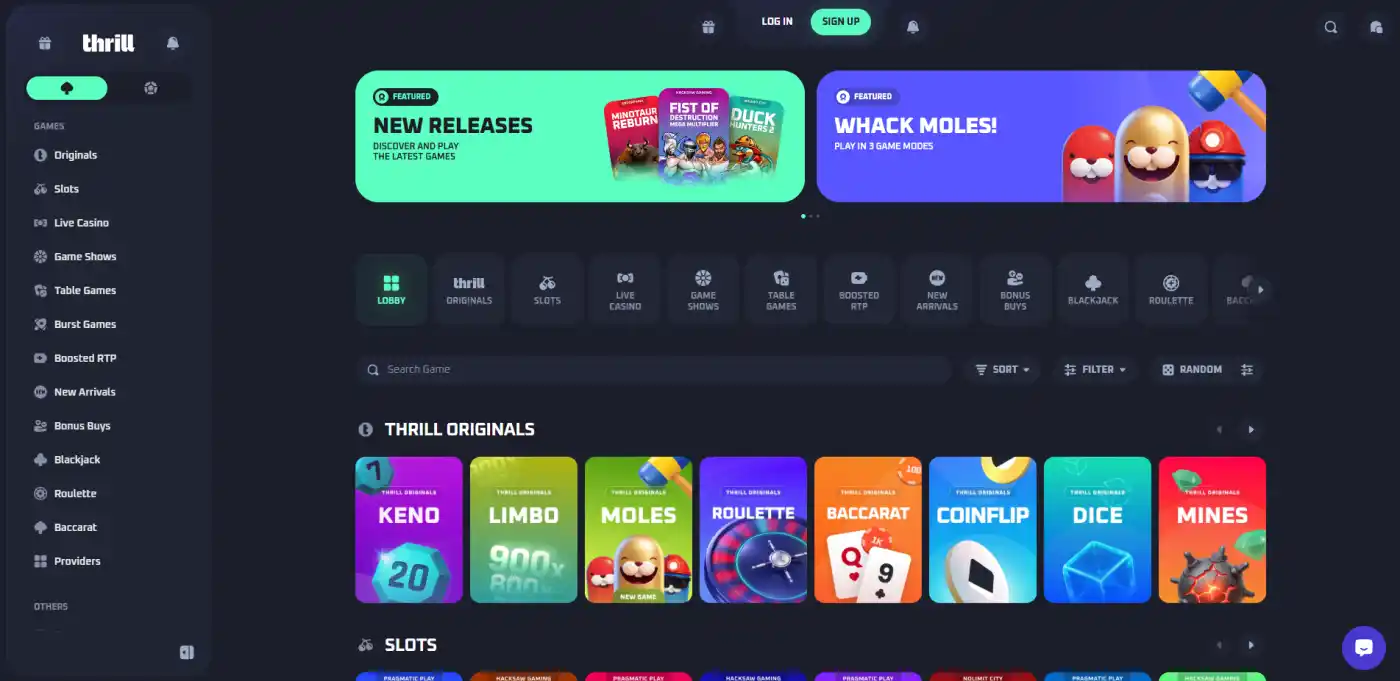
- The casino lobby spans third-party games, live tables and Thrill Originals
- A quick email signup does not end the account-verification story
- Mobile use stays centered on the responsive web interface
- Independent trust signals point in very different directions
- Questions that matter before using Thrill
- Thrill combines broad crypto access with a trust split worth treating seriously
Thrill puts crypto access ahead of a conventional casino setup
The defining pattern is not a single headline feature. Thrill connects a broad set of crypto rails to a large casino lobby and keeps rewards running through XP rather than a one-time first-deposit package. That gives the account a continuous progression model, but it also makes payment routing and later account checks more important than they might look during sign-up.
- Launch2025
- Crypto assets15 supported
- RewardsXP level-up system
- Game catalog2,000–4,000+ reported range
- Studios30+ represented
- Originals12 listed titles
The range in total game counts is worth reading literally rather than forcing it into one fixed figure. Different inventories and snapshots produce counts from roughly two thousand to four thousand or more, so the useful conclusion is breadth, not a permanent catalog total. The same logic applies to provider totals: the stable signal is a roster of more than 30 studios, including Pragmatic Play, Evolution Gaming, NetEnt, BGaming, Hacksaw Gaming, Relax Gaming, Nolimit City, Endorphina, Fantasma Games, Live88 and OneTouch.
| Area | Thrill setup | Practical consequence |
|---|---|---|
| Payments | 15 assets across multiple networks | The asset name alone is not enough; the sending and receiving network has to match. |
| Rewards | XP progression instead of a traditional welcome bonus | Value is spread across ongoing rakeback, cashback, reloads and milestones rather than one deposit event. |
| Games | Third-party catalog, live tables and Thrill Originals | Provider games and in-house provably fair titles need different ways of thinking about fairness and variance. |
| Account | Email-first registration with later risk-based checks possible | A fast start does not guarantee that document review will never be requested at cashout. |
| Mobile | Responsive, app-style web interface | Casino use is centered on the browser across screen sizes. |
Network choice can change the payment experience before the game starts
Thrill supports BTC, ETH, USDT, USDC, DAI, LINK, SHIB, LTC, DOGE, TRX, BNB, SOL, POL (MATIC), BCH and XRP. Its network coverage includes Bitcoin, Ethereum, Tron, Solana, BNB Chain, Polygon, XRP Ledger, Arbitrum and Litecoin, while USDT is available across several chains. That breadth gives a user more routing options, but it also creates more chances to choose the wrong network.
The important distinction is between an asset and its transport layer. A USDT balance can exist on more than one chain, and the deposit address shown for one chain should not be treated as interchangeable with another. Crypto transfers are generally irreversible once broadcast, so the safer habit is to copy the exact address, check the network label in the cashier, and compare the first and last characters before sending. The dedicated Thrill payments guide maps the supported assets and network choices in more detail, while the deposit walkthrough focuses on the pre-send checks.
- Choose the crypto asset in the cashier and note the network attached to the deposit address.
- Select the same network in the wallet or exchange that will send the funds.
- Review the network fee before confirming, because Thrill's payment model leaves blockchain fees with the user.
- Send only after checking the address and network pair; a wrong-chain transfer can be difficult or impossible to reverse.
Thrill does not add a platform payment fee, leaving the blockchain network fee as the direct transfer cost. A third-party fiat on-ramp is also available through providers including MoonPay and Swapped, with a cited service-fee range of about 3.5%–4%. That is a different cost layer from a blockchain fee: the on-ramp charge belongs to the conversion service, while network fees belong to the chain that moves the crypto.
Cashout planning
Check how a cashout amount fits the current cashier
Thrill's withdrawal minimum varies by asset and network. The brand positions withdrawals as instant and without a maximum limit, while Trustpilot reviews include reports of larger cashouts taking longer and verification being requested later in the process. Use the values shown in the current cashier as the working limits for your session.
Range not fully entered
Enter both current cashier bounds to compare the amount. Until then, the checker reports timing and review exposure only.
Network confirmation time varies by network. This checker does not predict payout time.
No account-review flag is selected.
Rewards work through XP progression rather than a first-deposit headline
Thrill does not use a traditional first-deposit welcome bonus. Instead, rewards are organized around XP and level progression, with rakeback, cashback or lossback, reloads, level-up rewards and milestone benefits. That changes the question from “what do I get for the first deposit?” to “what activity creates XP, which rewards unlock at each stage, and what conditions apply when a reward is used?”
- Welcome structure
- No conventional first-deposit bonus; progression centers on XP.
- Rakeback
- Advertised up to 70%, depending on tier.
- Cashback/lossback
- 10% is listed as part of the tier-dependent reward system.
- VIP ladder
- Thrill's VIP structure is described as 16 levels from Base to Obsidian.
- Milestones
- VIP-host access is associated with 1M XP, while custom reloads are associated with 2.5M XP.
Those percentages should not be read as automatic net returns. Rakeback typically refers to a share of gaming activity or house-edge-derived value, while cashback or lossback is tied to a different calculation basis. A user can wager a large amount and still finish with a loss even when a reward percentage applies. The Thrill VIP guide separates percentage-based benefits from milestone benefits, and the rewards guide explains why an XP system behaves differently from a classic deposit match.
Percentage rewards need a base
A percentage only becomes meaningful once you know what it is applied to. Turnover, theoretical loss and net loss can produce very different amounts even when the displayed percentage is identical.
Milestones are threshold events
XP milestones work more like gates: the account has to reach a defined level before a benefit such as host access or a custom reload becomes relevant.
Reloads shift attention to repeat use
A reload-based model spreads promotional value across later sessions instead of concentrating it in the first deposit. That makes current terms more important than a single headline offer.
Thrill also runs a weekly race or leaderboard as part of the broader XP reward structure. Promotions can change faster than the underlying progression system, so current reward terms matter more than a historic headline amount.
The casino lobby spans third-party games, live tables and Thrill Originals
The total game count varies materially by source, from roughly 2,000 to more than 4,000. The useful takeaway is that Thrill runs a large catalog rather than a small originals-only casino. The provider list includes established slot and live-casino studios, while the in-house layer adds a separate set of provably fair games.
- 2,000–4,000+reported game range
- 30+studios represented
- 12listed Thrill Originals
- 98.15%–99.48%stated RTP range for originals
For third-party content, the provider name is useful because it tells you who designed the game mechanics, paytable and underlying RNG implementation. For live tables, the provider also shapes the studio format, table limits and stream presentation. Thrill's live roster includes Evolution Gaming, Pragmatic Play Live, OneTouch and Live88, with observed counts around 80+ to 93 live tables. The live-casino section separates provider choice from general issues such as stream latency and network stability.
Thrill Originals are a different category. The listed 12-title set includes Crash, Plinko, Dice, Mines, Keno, Limbo, Roulette, Baccarat, Coinflip, Blackjack Multi-Seat, Hilo and Slide. They are presented as provably fair, with stated RTPs from 98.15% to 99.48%. Provably fair verification is useful for checking whether a disclosed seed-and-hash process reproduces a particular result; it does not make a future result predictable, remove house edge, or reduce short-term variance.
What can be checked directly
- Provider identity for third-party games.
- Seed/hash relationships where a provably fair verifier is provided.
- Game rules and listed RTP information before play.
What those checks do not prove
- A high RTP does not promise a winning session.
- A provably fair result does not predict the next round.
- A large catalog does not mean every title remains available at all times.
The full Thrill games guide maps the provider and category layers, while the Thrill Originals guide goes deeper into the verification concept and the listed in-house titles.
A quick email signup does not end the account-verification story
Thrill lets a user register with an email address and does not require document upload at the start. That is the low-friction part of onboarding. The more important account-lifecycle detail is that risk-based KYC and AML checks can be triggered later, including around larger cashouts or activity that receives additional review.
This distinction matters because “no upfront KYC” is not the same as permanent anonymity. Trustpilot user reports describe later verification requests, particularly during cashout. That does not establish that every withdrawal receives the same treatment, but it does mean a user should be prepared for identity or source-of-funds questions even after an account has been active for some time.
- Account creation begins with email registration rather than an initial document upload.
- Normal casino activity can proceed while the account remains outside a review trigger.
- A larger cashout or flagged activity can introduce a request for verification or additional account review.
- Blockchain confirmation begins only one part of the cashout journey; an account review can add a separate time layer.
Mobile use stays centered on the responsive web interface
Thrill is presented as a responsive, app-style web experience. That means the main casino flow is designed to adapt inside a mobile browser rather than requiring a separate interaction model for deposits, games, rewards and cashouts. For a crypto casino, this matters because the browser often sits beside a wallet or exchange app during deposits and withdrawals.
A practical mobile workflow is to keep the cashier open while checking the destination network in the sending wallet, then return to the browser to verify the address before broadcasting the transfer. On a smaller screen, copying and pasting reduces transcription risk, but it does not replace checking the network label. The same principle applies at cashout: the wallet address and chain need to match the selection shown in the cashier.
The account also includes an integrated sportsbook, and bets can feed the same XP loyalty system.
Independent trust signals point in very different directions
Thrill has a pronounced split between expert-style assessment and user-review sentiment. Casino Guru lists a Safety Index of 8.1, labeled “High,” and reports no unfair or predatory terms in its T&C assessment. Trustpilot, by contrast, shows a TrustScore around 2.1/5 from 132 reviews, with roughly 66% of ratings at one star.
The negative Trustpilot reports cluster around delayed or blocked larger withdrawals, KYC requests after wins, support friction and allegations about originals or RTP. Those are user reports rather than proof that game outcomes were manipulated. They still matter because they describe the parts of the customer journey most likely to create disputes: cashout timing, verification and communication.
What the expert-style signal says
- Casino Guru Safety Index: 8.1, labeled “High.”
- No unfair or predatory T&C clauses identified in that assessment.
- No relevant complaints identified in the same Casino Guru summary.
What the user-review signal says
- Trustpilot TrustScore is around 2.1/5.
- About two-thirds of ratings are one star.
- Cashout delays and later verification are recurring complaint themes.
When two trust signals disagree this sharply, the most useful response is to narrow the question. Terms quality is one issue; user experience during a difficult cashout is another. A clean terms review does not erase later support complaints, and a cluster of complaints does not by itself prove that every account will encounter the same problem. For account mechanics, use the account lifecycle guide; for payment mechanics, use the cashout guide.
Questions that matter before using Thrill
What is Thrill Casino?
Thrill is a crypto-native casino launched in 2025. It supports 15 crypto assets across multiple blockchain networks and combines third-party casino games with Thrill Originals and an XP-based reward system.
Does Thrill have a traditional welcome bonus?
No. Thrill uses an XP-based level-up and reload reward structure instead of a conventional first-deposit welcome bonus.
How many cryptocurrencies does Thrill support?
Thrill supports 15 crypto assets, including BTC, ETH, USDT, USDC, DAI, LINK, SHIB, LTC, DOGE, TRX, BNB, SOL, POL (MATIC), BCH and XRP. Several assets can use more than one network.
Does Thrill require KYC?
Thrill allows email registration without document upload at the start, but risk-based KYC and AML checks can be triggered later, including around larger cashouts or flagged account activity. It should not be treated as a guarantee of permanent anonymity.
How fast are Thrill withdrawals?
Thrill positions withdrawals as instant, but blockchain confirmation speed depends on the selected network and account review can add time. The current cashier and any review request are the practical references for a specific cashout.
Are Thrill Originals provably fair?
Thrill Originals are presented as provably fair. The listed set includes 12 titles, and provably fair verification is designed to let a player check the relationship between seeds, hashes and an individual game result rather than predict future outcomes.
Thrill combines broad crypto access with a trust split worth treating seriously
Thrill's clearest strengths are structural: 15 supported crypto assets, multi-chain routing, a broad casino catalog, live providers, a 12-title originals set and an XP reward system that continues beyond the first deposit. The main friction sits in the cashout and account lifecycle. Withdrawals are marketed as fast, but network confirmation and risk-based review are separate steps, and user-review sentiment is materially weaker than Casino Guru's terms-focused assessment.
The practical approach is to keep each decision narrow. Match the asset and network before sending crypto, read current cashier limits instead of relying on a generic “no limits” phrase, treat later KYC as possible even after email-only signup, and evaluate rewards by their calculation base rather than by the headline percentage. That framework explains more about the real experience than any single score or promotional number.